Sirens in the Shires: Civil Defence, Preparedness and the Politics of Everyday War
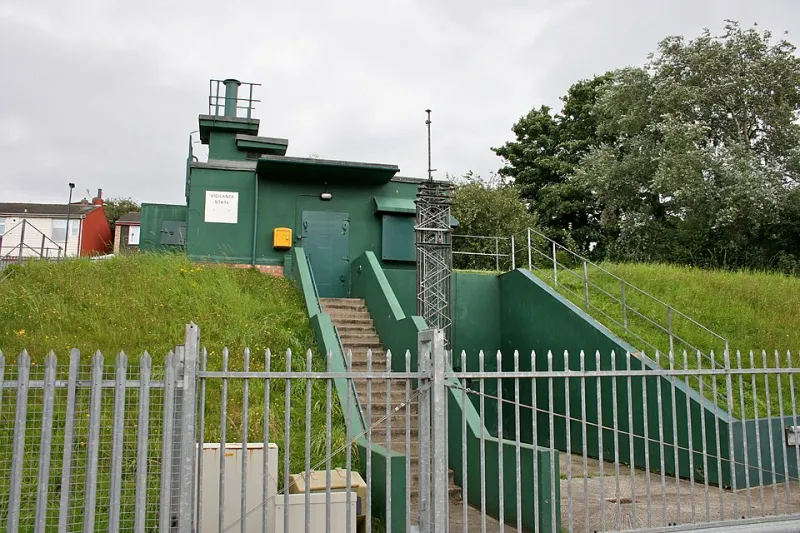
Photo: Photograph by Mike Peel (www.mikepeel.net)., CC BY-SA 4.0, via Wikimedia Commons
The British landscape is littered with the remains of civil defence. There are concrete bunkers in quiet fields, control centres beneath towns, rusting sirens on rooftops and faded notices in old public buildings. Most are overlooked. Yet in 2026 the language of preparedness is returning to British politics, and with it a set of questions about what civil defence is for. Is it a humane project to protect civilians from harm? Or is it a way of making war feel ordinary, manageable and close at hand?
The answer depends less on the concrete than on the politics around it. Civil defence has always been Janus-faced. It can shelter people, warn them of danger and help communities recover. It can also accustom them to the idea that catastrophe is normal, that emergency powers are necessary and that the civilian population is part of the battlefield.
The Concrete Legacy
Modern British civil defence took shape during the Cold War. The Civil Defence Corps, established in 1949, trained volunteers in rescue, welfare and communications. Local authorities prepared control centres and emergency plans. Sirens were installed to warn of attack. In the 1980s, regional seats of government and hardened bunkers were maintained in case central government had to relocate. The Royal Observer Corps maintained posts to monitor nuclear bursts until it was stood down in 1991.
The Civil Defence Corps itself was disbanded in 1968, a victim of changing strategy and cost. But the infrastructure and the habits persisted. After the Cold War, civil defence was reframed as civil protection. Floods, storms, foot-and-mouth disease, terrorism and then the Covid-19 pandemic pushed emergency planning away from atomic attack and towards an all-hazards approach. The Civil Contingencies Act 2004 gave local resilience forums a central role, bringing councils together with police, fire, health and environment agencies.
In 2026, the vocabulary has shifted again. Preparedness, resilience and whole-of-society security are increasingly common in white papers, parliamentary debates and local plans. The emergency alert system, tested nationally in 2023, is now part of the public landscape. Councils review contingency plans. Schools and hospitals discuss business continuity. The language is rarely militaristic, but it is unmistakably about being ready for disruption on a national scale.
From Atomic Anxiety to All-Hazards Resilience
The history matters because it shows how easily civil defence can change its purpose. In the 1950s, civil defence pamphlets tried to reassure a public that nuclear war might be survivable. Critics saw that as a dangerous illusion. In the 1980s, peace camps and protests challenged the logic of preparing for a war that many believed could not be limited. After the Cold War, civil protection became more technocratic: a matter of flood defences, pandemic plans and local emergency exercises.
That all-hazards tradition is valuable. A local resilience forum that plans for flooding is not preparing for war. It is doing the unglamorous work of keeping people safe. The same is true of emergency planning for heatwaves, power cuts or public disorder. Civil protection at its best is neither warlike nor pacifist; it is simply the state doing its duty to protect civilians from foreseeable harm.
But the return of preparedness language in 2026 raises a new question. When national security documents speak of resilience, and when local authorities are asked to plan for hostile threats as well as natural ones, the boundary between civil protection and civil defence begins to blur. That blurring is not necessarily wrong. In a contested world, civilian infrastructure can be a target. Yet it does place a burden on democratic oversight. Preparedness can be a shelter from harm or a pathway to securitised thinking, and the difference is often political rather than technical.
The Peace-Building Case
There is a serious case for civil defence as a peace-building tool. Protecting civilians is a humanitarian act. Clear warnings, usable shelters, evacuation plans and resilient local services reduce suffering. They also reduce panic, which can be destabilising in a crisis. In this sense, civil defence is a form of care: it treats ordinary people as ends in themselves rather than as passive victims of strategy.
Local resilience forums can also build social capital. They bring together people who would not otherwise meet: council officers, faith groups, volunteers, health workers and emergency services. That kind of cooperation can strengthen community trust. In a country as centralised as Britain, local preparedness can be a modest check on the tendency to treat resilience as a matter of national command.
If civil defence is framed transparently as civilian protection, it can sit comfortably with a peace-building agenda. The Pax Britannica ideal, at its best, was never only about power. It was also about order, public safety and the idea that ordinary life should be shielded from the worst. A civil defence programme that protects people regardless of the cause of a crisis can be part of that inheritance.
The Normalisation Risk
Yet there is a real danger. Preparedness can normalise war-thinking in everyday life. Bunkers and sirens are potent symbols. They tell citizens that attack is a live possibility and that the state's response will be technical and administrative. That may be truthful, but it can also accustom people to the idea that conflict is inevitable. Emergency powers can expand quietly. Local planning can become securitised. Resources can be diverted from social care or flood defence towards speculative threats.
The risk is greatest when civil defence is presented as a patriotic duty rather than a public service. If preparedness becomes a form of national mobilisation, it can stigmatise dissent and marginalise those who ask whether the threat is being exaggerated. It can also blur the line between civilian and military authority, which is precisely the distinction that a liberal democracy should guard most carefully.
A Cautious Revival
Britain's quiet civil defence revival is therefore neither purely benign nor inherently militaristic. It depends on framing, oversight and purpose. If it is transparent, lawful and focused on protecting civilians, it can be a genuine peace-building tool. If it normalises war, expands emergency powers without scrutiny and treats citizens as subjects of mobilisation, it risks eroding the very civilian life it claims to defend.
The bunkers in the shires are not simply relics. They are reminders that preparedness is never neutral. In 2026, the task is to make civil defence answerable to the public it protects, and to ensure that the language of resilience does not become a quiet way of making war ordinary.