The British Peace Illusion: Five Myths About Pax Britannica and Their Lessons for 2026
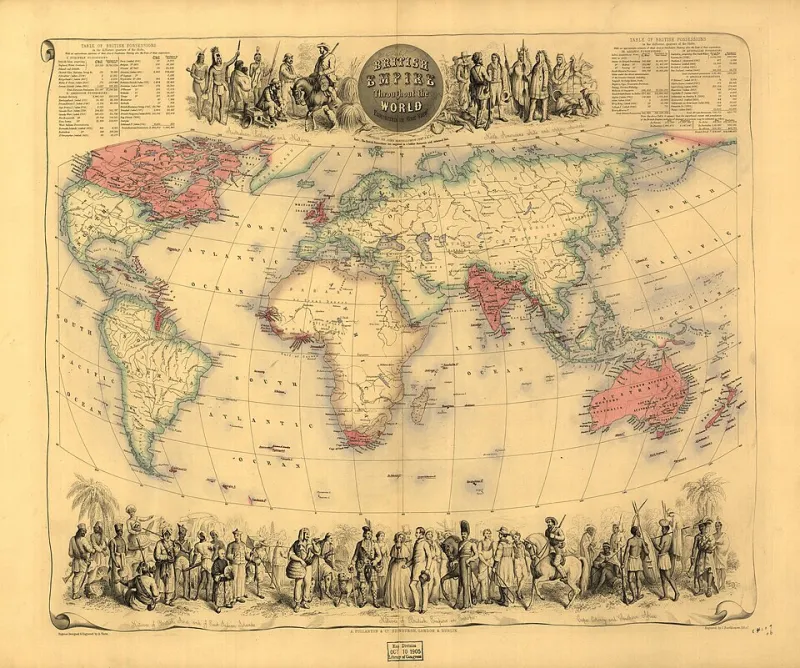
Photo: John Bartholomew, Public domain, via Wikimedia Commons
Pax Britannica is a seductive phrase. It suggests order, stability and a world made safer by British power. It has been used by historians, politicians and commentators for more than a century, and it still lingers in debates about Britain’s place in the world. Yet the phrase is not a neutral description. It is an argument—and often a flattering one. Five myths about the British peace remain especially persistent, and each has something uncomfortable to say about British foreign policy in 2026.
Myth One: The British peace kept the world stable
The first myth is the broadest: that British hegemony provided a kind of global order that would otherwise have collapsed into chaos. There is a kernel of truth in the claim that British naval power and financial reach shaped the nineteenth-century international system. But stability for whom? The British peace coexisted with colonial conquest, frontier violence, famine, coercion and repeated small wars. It was a peace among the great powers in Europe, not a peace experienced by much of Asia, Africa or Ireland.
The contemporary lesson is scepticism. British policymakers in 2026 often speak of a rules-based order as if it were a fragile inheritance that only Britain and its allies truly understand. That rhetoric can be valuable, but it becomes self-serving when it skips over the illiberal and coercive aspects of the order Britain once helped to build. A foreign policy that claims to defend stability should be honest about what stability has cost in the past—and who was excluded from it.
Myth Two: Britain acquired its empire in a fit of absence of mind
This is one of the most enduring lines in British historical culture: the idea that the empire was acquired reluctantly, almost accidentally, by men who were looking the other way. It is a comforting image. It turns imperial expansion into a series of unfortunate events rather than a political project. Historians have long challenged it. Empire was made by merchants, soldiers, missionaries, administrators and politicians who often knew exactly what they were doing.
The lesson for 2026 is that foreign policy choices are rarely accidental. Britain’s global role is not a fixed inheritance that simply happens to the country. It is the product of decisions about defence spending, alliances, trade and military deployment. If Britain chooses to prioritise the Indo-Pacific, or to reduce its peacekeeping footprint, or to tighten its aid budget, those are choices with consequences. The myth of absence of mind encourages a passive view of statecraft. A serious foreign policy requires the opposite.
Myth Three: Free trade made empire benign
Free trade is often presented as the gentle face of British power. The Empire was supposedly a network of commerce rather than conquest, and British influence was spread through markets rather than muskets. This myth is particularly useful for modern debates about economic statecraft. It allows Britain to present its global role as commercial and civilian rather than military and coercive.
But informal empire was still empire. Gunboat diplomacy, unequal treaties, opium and debt collection were part of the same system. British power was exercised through financial pressure and naval threat as well as through trade. The contemporary lesson is not that trade is inherently imperial. It is that economic statecraft can be coercive, and that rules-based language can mask asymmetries of power. In 2026, as Britain seeks new trade relationships and tries to project influence through investment and technology, it should be alert to the gap between liberal rhetoric and practical leverage.
Myth Four: Britain was a reluctant imperialist
Related to the myth of absence of mind is the claim that the British public and political class were fundamentally reluctant imperialists. In this telling, empire was a burden imposed by circumstance, and British power was exercised with regret. There is evidence of ambivalence, but there was also enthusiasm. Empire was celebrated in schools, churches, exhibitions and popular culture. It provided careers, profits and a sense of national purpose. Reluctance was one strand of British opinion, not the whole story.
The lesson for 2026 concerns national narratives. British identity still carries imperial residue, and debates about defence, aid and immigration are often shaped by unacknowledged assumptions about Britain’s historic role. A foreign policy that cannot discuss empire honestly will struggle to explain why other countries view British power with suspicion. The point is not to induce guilt but to encourage accuracy. Nations that misremember their past tend to misjudge their present.
Myth Five: Britain was a uniquely moral power
The final myth is the most flattering: that British power was different because Britain was a force for good. Abolitionism, parliamentary government and the rule of law are real parts of the British tradition. But they coexisted with coercion, racial hierarchy and violence. The British state could denounce slavery while protecting slave-owning interests, and it could speak of civilisation while waging brutal campaigns. Moral language was not absent from empire; it was often part of how empire was justified.
The contemporary lesson is that claims to virtue need evidence. In 2026, British ministers frequently describe the UK as a force for good in the world. That may be a genuine aspiration, but it is not a policy. It must be demonstrated through consistent support for international law, credible peacekeeping contributions, honest arms export controls and a willingness to accept criticism. The myth of unique morality encourages self-congratulation rather than self-examination.
History as caution, not comfort
Pax Britannica was not a single peace, and it was not a simple gift to the world. It was a power system, with beneficiaries and victims, order and violence, rhetoric and reality. That does not mean Britain has nothing to be proud of, or that its contemporary foreign policy should be paralysed by history. It means the past should be used as a caution rather than a comfort.
In 2026, British foreign policy faces hard choices about defence spending, alliances, peacekeeping and its relationship with a more contested world. Those choices will be shaped by how Britain understands itself. The myths of Pax Britannica still provide a comforting story about global responsibility and moral purpose. But a mature foreign policy needs a more honest story—one that recognises the limits of British power, the ambiguities of British history and the difference between claiming to be a force for good and actually being one.