The Ledger of Coercion: British Sanctions and the Search for Peace in 2026
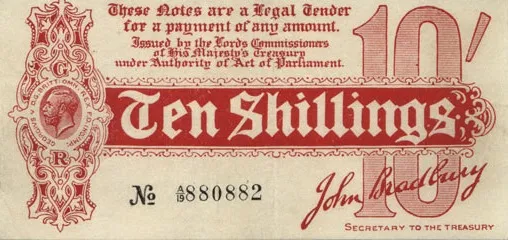
Photo: HM Treasury; signed by Permanent Secretary to the Treasury, John Bradbury, 1st Baron Bradbury (in office 1913-19), Public domain, via Wikimedia Commons
Sanctions have become the quiet workhorse of British statecraft. In an era when deploying troops is politically costly and militarily uncertain, asset freezes, visa bans and trade restrictions offer a way to punish aggression without firing a shot. For a country that has long framed itself as a peacekeeping power, the appeal is obvious. Yet the very features that make sanctions attractive—their flexibility, their reversibility, their low visibility—also make them difficult to scrutinise and easy to misuse. The question for 2026 is not whether Britain should use economic statecraft, but whether it can articulate a doctrine clear enough to withstand the moral and parliamentary tests that military action has long faced.
From Blue Helmets to Blacklists
The post-Cold War assumption that peacekeeping would be done by blue-helmeted soldiers has faded. Operations in the Balkans, Sierra Leone and Afghanistan were followed by a more cautious era, in which Western governments grew wary of large deployments and domestic audiences grew sceptical of distant wars. Russia’s full-scale invasion of Ukraine in 2022 accelerated a shift that was already under way: the frontline of coercion moved from the battlefield to the bank ledger.
Britain has been at the forefront of this shift. Successive UK governments have expanded the designation of individuals and entities, tightened financial restrictions and coordinated with allies on price caps and export controls. In 2026, sanctions are no longer a peripheral adjunct to diplomacy. They are a primary means by which Britain signals resolve, imposes costs and tries to shape the calculations of adversaries. The language of peacekeeping has migrated into the language of sanctions: the aim is not merely to punish, but to deter, constrain and create the conditions for a negotiated settlement.
That ambition is understandable. Sanctions can be applied quickly, adjusted without a troop deployment and targeted at elites rather than populations in principle. They also fit a middle-power role: Britain can act through financial markets, legal services and shipping insurance even when it cannot act through force. But the translation from military peacekeeping to economic coercion is not straightforward. Peacekeepers are visible, mandated and accountable to international institutions. Sanctions are dispersed, technical and often opaque.
How the Machinery Works
The mechanics matter because they determine who bears the cost. In the UK, asset freezes are administered through the Office of Financial Sanctions Implementation, while visa bans are handled by the Home Office and trade restrictions by a range of departments. Designations are made under statutory regimes, many of which were reshaped after Brexit. Licences allow certain transactions—humanitarian aid, legal fees, basic needs—to continue. In theory, this creates a targeted system that hits those responsible for aggression while sparing the vulnerable.
In practice, the chain is fragile. Banks and insurers are risk-averse. A designation can cause a private institution to withdraw from an entire sector or region rather than risk a penalty. Humanitarian organisations report delays, refused payments and difficulties moving medical equipment. The result is what practitioners call overcompliance: the de-risking of whole populations because the legal boundary is unclear. A visa ban on a minister may be symbolically satisfying, but a frozen bank account or a blocked shipment can affect a hospital.
The British system has improved in some respects. Guidance on humanitarian exceptions has been clarified, and the government has published more information on designations. Yet the gap between the legal text and the lived reality remains wide. Sanctions are designed in Whitehall and Brussels and Washington; their effects are felt in fragile economies where the state may be predatory, the banking system may be thin and the informal economy may be the only safety net.
The Civilian Cost
The ethical dilemma is not that sanctions never work. They can raise the cost of aggression, complicate weapons procurement and deny kleptocrats their yachts and London properties. The dilemma is that their costs are unevenly distributed. Authoritarian governments can shift the burden onto citizens, using shortages as a pretext for control. Women, children and minority communities often absorb the shock. Remittances may dry up. Civil society organisations may lose access to foreign funding. The very people who might pressure a regime are sometimes the first to be squeezed.
This does not mean sanctions are inherently illegitimate. It means they require a higher standard of evidence and review than they currently receive. A peacekeeping operation would be judged on whether it protected civilians and upheld a mandate. A sanctions regime should be judged on whether it achieved its stated political objectives and whether its humanitarian safeguards worked. At present, Britain rarely publishes such an assessment in any systematic way.
Parliament’s Blind Spot
Parliament has a role, but it is uneven. Sanctions are often imposed through statutory instruments, which receive limited debate. Select committees can scrutinise policy, and judicial review can test individual designations, but there is no equivalent of the regular reporting that accompanies military deployments. The result is a policy area of growing importance that remains largely executive-led.
This matters for legitimacy. If sanctions are to be presented as a humane alternative to war, they need the kind of public accountability that war-making has long attracted. That means annual reports on objectives, costs and humanitarian impact. It means clearer criteria for delisting. It means parliamentary committees being able to examine not only whether the rules are being followed, but whether the strategy is working.
Towards a British Sanctions Doctrine
A clearer British doctrine would not resolve every dilemma, but it would make the trade-offs explicit. It could begin with a simple statement: sanctions are a means of political coercion, not an end in themselves. Each regime should have published objectives, a theory of change, a humanitarian impact assessment and a review date. Coordination with allies should be pursued, but not at the expense of clarity about British responsibilities.
The doctrine should also acknowledge the limits of economic statecraft. Sanctions can constrain, but they rarely compel a determined leader to abandon a core interest. They work best when embedded in a wider strategy that includes diplomacy, deterrence and, where necessary, peacekeeping. Britain’s claim to be a peacekeeping nation will ring hollow if its sanctions policy is seen as a form of collective punishment. It will be more credible if it treats economic coercion as a serious instrument with serious consequences—and holds itself to the same standards of scrutiny it demands of others.