Crown, Commons, Court: Who Actually Decides When Britain Fights?
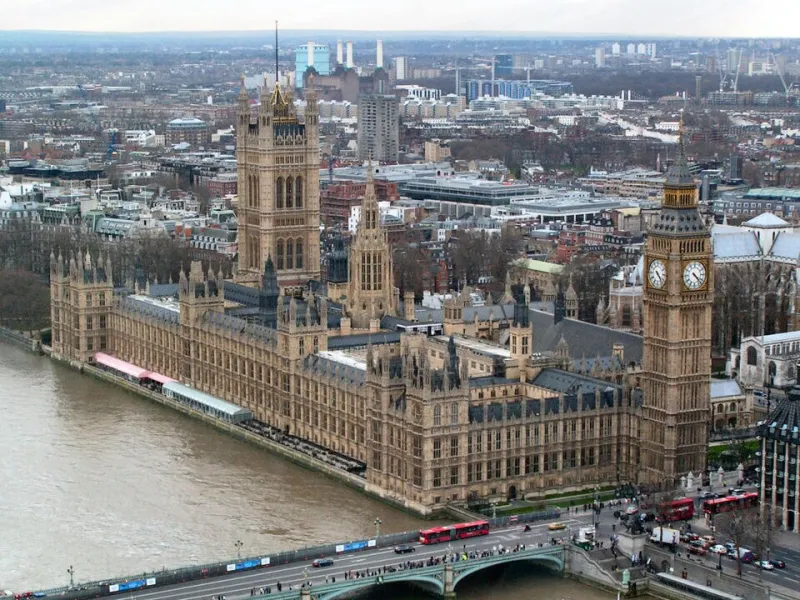
Photo: DaniKauf, CC BY-SA 3.0, via Wikimedia Commons
There is a persistent oddity at the heart of the British constitution. A prime minister may send warships and aircraft into harm’s way without recourse to a single section of an Act of Parliament, while the same government would need statutory authority to alter the licensing hours of a pub. War, in law, remains a prerogative business.
That anomaly has been tolerated because convention has done most of the work. Since the Iraq war, ministers have accepted in practice — though never quite in doctrine — that the House of Commons should be asked to approve significant military commitments. But a convention is not a rulebook, and the distance between the two is now the subject of renewed argument.
The prerogative, in practice
The power to declare war and to deploy the armed forces belongs historically to the Crown and is exercised today by the Prime Minister on ministerial advice. No Act of Parliament confers it; no Act regulates it. Treaties have been subject to statutory machinery since the Constitutional Reform and Governance Act 2010, but the commitment of troops has not.
The result is a discretion that is broad in principle and disciplined mainly by politics. Ministers must answer to the Commons, to select committees, to the press and ultimately to the electorate. That is a real constraint. It is not, however, a legally enforceable one, and it offers no settled procedure for the moments when speed matters most.
What the Commons has gained — and what it has not
The modern convention is usually dated to 2003, when the Commons voted on the Iraq deployment. It was tested in 2011 over Libya, famously refused in 2013 over Syria, and reaffirmed in 2015 when MPs authorised the extension of airstrikes. In April 2018, by contrast, the government joined allied strikes on Syrian chemical weapons facilities without a prior vote, citing urgency and the limited and specific nature of the action.
Those precedents are consistent enough to be described as a convention and inconsistent enough to be doubted as one. The gaps are wide. Special forces operate under a veil of ministerial accountability that Parliament rarely pierces. Training missions, logistical support, intelligence sharing, arms exports and cyber operations can draw Britain into a conflict without ever triggering a vote on combat operations. So can the quiet embedding of personnel in allied formations.
Committees of both Houses have repeatedly recommended codification. Private Members’ Bills have been introduced and have duly expired. Successive governments have preferred to insist that they would not go to war without the Commons where possible, while declining to be bound by a rule that would remove their freedom of manoeuvre.
Where the courts stand
The judges have been careful. In the litigation that followed the Iraq war, the House of Lords declined to review the decision to take the country to war, holding that the question was not justiciable in the way the claimants sought. The courts will not pronounce on whether a war is wise, or even on whether it is lawful under international law in the abstract.
They will, however, police the edges. Judicial review of arms export licensing has, in the past, forced ministers to revisit decisions with direct consequences for a conflict abroad. The prorogation litigation of 2019 demonstrated that the courts will intervene where the machinery of the constitution itself is abused. And the publication of the Attorney General’s legal basis for action has become an expectation, if not yet an obligation. The boundary, in short, is real but movable, and it moves in response to political pressure rather than by design.
Why 2026 has reopened the question
The argument has acquired fresh urgency for three reasons. The first is tempo: commitments to allies, maritime security operations and support to partners under attack can escalate faster than a parliamentary timetable allows. The second is ambiguity: much modern military assistance sits somewhere between peace and war, and the convention has nothing to say about the grey zone. The third is duration: deployments now outlast parliaments, and MPs increasingly ask what happens when a commitment authorised by one government is quietly widened by its successor.
Any British contribution to a ceasefire monitoring or stabilisation arrangement — a live prospect in more than one theatre — would sharpen the difficulty further. Peacekeeping sits awkwardly between the two categories the constitution recognises: not quite belligerency, certainly not routine administration. Who authorises it, under what legal basis, and with what power to withdraw, are questions that ought not to be answered improvisationally.
The peacemaking test
Britain’s claim to be a force for peace rests substantially on its reputation for predictability. Allies plan around British commitments; partners in a fragile region read British signals to judge whether a guarantee will hold; mediators draw authority from the knowledge that the government speaking has a legislature behind it. An unwritten rule that can bend is, in that context, a weak foundation.
Codification would not make British decisions better. A statute could be drafted loosely, or waived in emergencies, or used by governments of any party to claim a mandate they do not really have. Nor would it remove politics from the question, which is where most sensible observers think it belongs.
What it would do is substitute a public procedure for a private judgment, and tell allies and adversaries alike how Britain decides. For a state that advertises itself as a broker rather than a belligerent, that clarity is not constitutional decoration. It is part of the instrument.