The Underwriter’s Flag: London, Maritime Risk and the Quiet Arithmetic of Peace
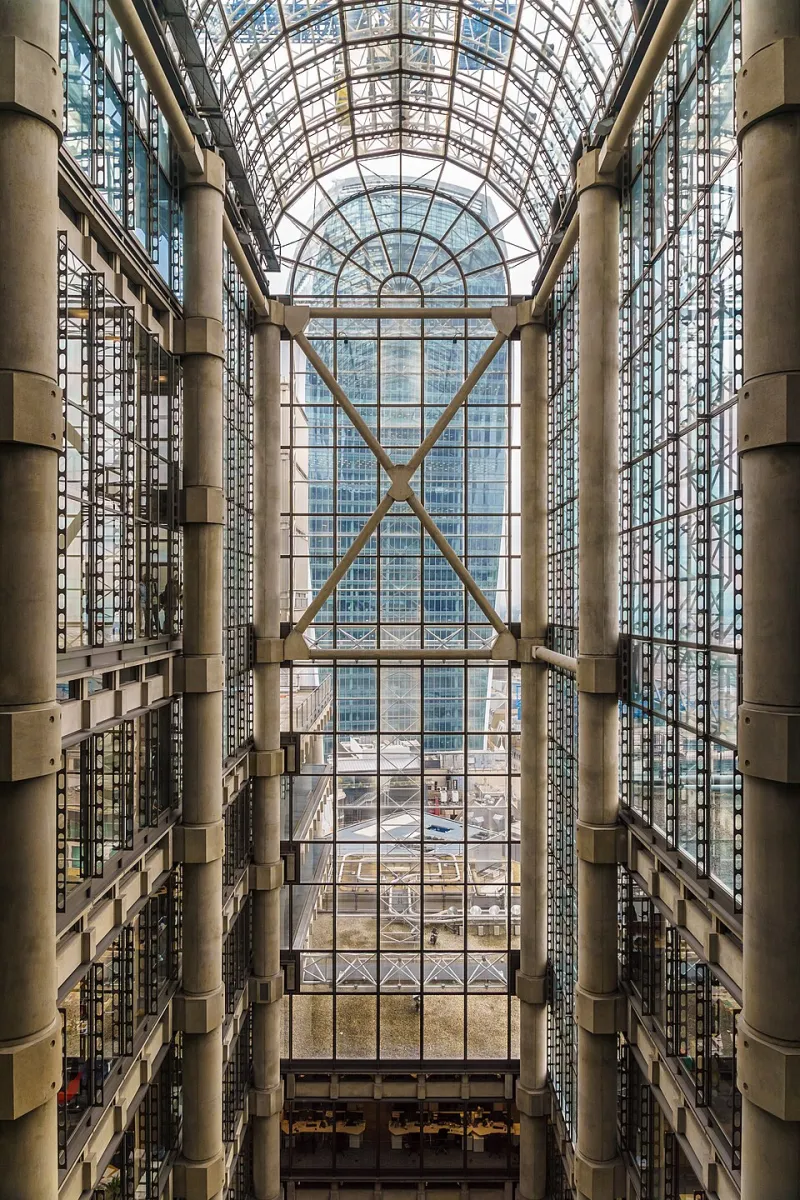
Photo: Colin, CC BY-SA 4.0, via Wikimedia Commons
At Lloyd’s, the day begins with slips of paper rather than communiqués. Brokers move between underwriters, placing risks that range from a container ship in the Red Sea to a bulk carrier loading grain in the Black Sea. No flag is raised, no treaty is signed. Yet the premiums agreed in that room, and in the wider London marine insurance market, can determine whether a voyage is commercially viable at all. In a year when shipping risk and sanctions compliance are again reshaping Britain’s place in global security, the underwriter’s desk deserves more attention than it usually receives.
A market that speaks in spreads
Marine insurance is one of Britain’s oldest commercial exports. The Lloyd’s market traces its origins to Edward Lloyd’s coffee house in late seventeenth-century London, where shipowners, merchants and underwriters gathered for news and cover. The Marine Insurance Act 1906 later codified a body of practice that had grown up around those informal exchanges. The result is a peculiar British institution: a private market with a global reach, a London address and an unofficial role in the conduct of foreign policy.
That role is not exercised through instruction. It is exercised through price. When the Joint War Committee, a market body rather than a government committee, designates a listed area, underwriters can charge additional premiums for voyages through it. The designation is not a prohibition. It is a signal, backed by capital, that a route carries heightened risk. Shipowners may still sail. Charterers may still pay. But the cost of cover becomes a factor in the commercial calculation, alongside fuel, freight rates and crew wages.
The Red Sea and the price of passage
Since late 2023, attacks on commercial shipping in the Red Sea and the Gulf of Aden have reminded British policymakers how quickly a maritime route can become a political variable. The disruption of 2024 forced many vessels to reroute around the Cape of Good Hope, adding days and fuel to journeys between Asia and Europe. In 2026, the risk picture is more varied but no less consequential. Insurers continue to assess whether particular transits are prudent, and the premiums they quote reflect intelligence, naval presence and the perceived credibility of deterrence.
This is where London’s quiet leverage becomes visible. A Royal Navy deployment or a multinational escort operation may reassure underwriters, but it does not set their rates. Conversely, a perceived gap in security can raise premiums even when governments insist that the route is open. The market is not a branch of the Foreign Office. It is a separate actor with its own appetite for risk, its own loss records and its own obligations to policyholders. That independence is precisely what makes its signals worth watching—and difficult for ministers to control.
Sanctions, compliance and the private foreign policy
War risk is only one part of the story. London’s insurance market also sits inside the machinery of sanctions compliance. Cover for a tanker suspected of belonging to Russia’s shadow fleet is not a neutral commercial choice. It engages the Office of Financial Sanctions Implementation, the Maritime Services Ban and the attestations that underwriters now require from owners and charterers. A refused policy can be as effective as a port state control inspection in closing a route.
This gives British insurers an unusual kind of diplomatic weight. They are not enforcing foreign policy in the manner of a customs agency, but they are pricing it. A sanctions regime that lacks market buy-in may leak; one that is absorbed into underwriting practice becomes harder to evade. The trade-off is that private institutions are being asked to make judgments with public consequences. Underwriters must assess ownership structures, voyage histories and cargo declarations. They are not courts, and they should not be treated as such. Yet their decisions can determine whether a sanctioned cargo moves or a humanitarian shipment sails.
The moral premium
Humanitarian shipping exposes the limits of this arrangement. A charity chartering a vessel to deliver food or medical supplies may face the same war-risk calculus as a commercial operator, even if its purpose is relief rather than profit. Insurers can offer concessions, and some do. But a market cannot easily distinguish between a cargo that sustains a civilian population and one that sustains a war economy. It prices risk, not justice.
That is not a reason to dismiss the market’s contribution. It is a reason to be precise about what it can do. London’s underwriters can help keep humanitarian corridors open by providing cover where none would otherwise exist. They can also, inadvertently, make relief more expensive. The difference often lies in coordination: between insurers, brokers, charities, the Department for Transport and the Foreign, Commonwealth and Development Office. Quiet diplomacy can lower a premium. It cannot abolish the risk that produced it.
A lever, not a rudder
The appeal of maritime underwriting as an instrument of British influence is that it looks technocratic. It does not require a parliamentary vote or a military deployment. It operates through the ordinary language of commerce: deductibles, exclusions, warranties and rates. For a country that prefers to describe itself as a force for peace, that is an attractive form of power. It is also an incomplete one.
A commercial city can price conflict, but it cannot resolve it. Lloyd’s can signal that a sea lane is dangerous; it cannot make it safe. The market can support sanctions; it cannot supply the political strategy that gives them purpose. If Britain wants its insurance market to serve peacebuilding rather than merely manage risk, it will need to treat underwriters as partners in a wider policy—not as a convenient substitute for one. The premium of peace, in the end, is paid in coordination as well as capital.