I am persuaded that this is a righteous Judgement of God upon these Barbarous wretches who have imbrued their hands in so much innocent blood, and that it will tend to prevent the effusion of blood for the future, which are the satisfactory grounds to such Actions, which otherwise cannot but work remorse and regret.
Oliver Cromwell to Speaker Lenthall, 17th September 1649
- Sir Arthur Aston Governor.
- Sir Edmond Verney Lieutenant Col: to Ormonds Regiment.
- Col: Fleming, of Horse.
- Lieutenant Col: Finglass, of Horse.
- Major Fitzgerald, of Horse.
- Eight Captains of Horse.
- Eight Lieutenants of Horse.
- Eight Cornets of Horse.
- Col: Warren, of Foot, with their Lieutenants, Majors, &c.
- Col: Walls, of Foot, with their Lieutenants, Majors, &c.
- Col: Byrne, of Foot, with their Lieutenants, Majors, &c.
- The Lord Taaffs brother, an Augustine Fryer.
- Forty four Captains, and all their Lieutenants, Ensigns, &c.
- Two hundred and twenty Reformado’s and Troopers.
- Two thousand Five hundred-Foot Soldiers, besides Staff-Officers, Chyrurgeons, &c. and many Inhabitants.
A list of the Officers and Soldiers slain at the storming of Drogheda, ordered by the Commons assembled in parliament to be forthwith printed and published. 2nd October 1649.
_______________________________________________________________________________________________
The following is adapted from the script for Season 3, Episode 4 of Pax Britannica. To listen, use the player above, and to find out more follow the links on this website or go to Pod.Link/Pax to subscribe on your app of choice.
Last week, we covered the attempt by the Marquis of Ormond to capture the city of Dublin, and its wildly successful defence by General Michael Jones. In the wake of the regicide of Charles I, Ormond’s new coalition secured almost the entire island of Ireland, except for the cities of Derry and Dublin. Ormond’s attempt to take Dublin, as unlikely as it had been to succeed, was firmly denied by Jones, who seized the opportunity of a botched night manoeuvre from some of Ormond’s men to roll them all the way back to their camp at Rathmines. The Battle of Rathmines effectively secured Dublin’s security and put the Royalists on the defensive. All in time for Oliver Cromwell’s army of conquest to make landfall.
The news of Rathmines reached Cromwell’s muster at Milford Haven on the 13th of August, and the new parliamentary Lord Lieutenant of Ireland was delighted at the news. He wrote, ‘this is an astounding mercy, so great and seasonable, that indeed we are like them that dreamed.’ Cromwell well understood the military consequences of Jones’ victory. He could land his army at Dublin without facing an immediate attack, and it gave him a free hand to decide his course of action. But beyond that, Cromwell was entirely convinced by the idea of providence - that God didn’t so much work in mysterious ways, but that he was very direct in his intervention. Cromwell firmly believed that God was literally on his side, and the victory at Rathmines was just another example - God wanted the Irish royalists defeated, and the New Model Army was His instrument.
With his affairs in order, and his army’s pay in tow, Cromwell set sail from Milford Haven in mid August, 1649. He arrived at Ringsend, which is now a suburb of Dublin, but in 1649 was a separate port. Cromwell disembarked his army and marched into Dublin in good order - Rathmines had ensured he’d face no resistance. Arriving in the capital, Cromwell set to work putting his campaign into action. Historian Martyn Bennet has emphasised that though his name is attached to it, this campaign was not Cromwell’s alone. Both of Parliament’s remaining commanders in Ireland - Major General Jones in Dublin and Charles Coote, up in Derry - became part of Cromwell’s decisionmaking. Cromwell was also soon joined by his son-in-law, Henry Ireton, and Lord Broghill, Roger Boyle. Jones became Cromwell’s second in command as his lieutenant general of horse. Ireton was made his major-general of infantry, although not before Cromwell attempted to give the position to someone else. Possibly to avoid accusations of nepotism, and possibly because he was unconvinced about Ireton’s military skill - he was a fine quartermaster and a better political theorist, but his record on the battlefield was mixed. Speaking of Ireton, he had sailed from England two days after Cromwell, intending to land his force on the south coast - but for now, the garrisons of the Munster ports remained loyal to Inchiquin, and he joined his father in law in Dublin.
Coote remained under siege in Derry, so we’ll leave him there for now. Broghill had been in England when Cromwell set off. Though he would later claim that Cromwell threatened to have Broghill arrested unless he joined the expedition, Bennet dismisses this as a post-restoration justification. Broghill was not brought along because of any exceptional military skill. No, his value to the campaign was his name, his reputation, and his connections. The Boyles were well known and well respected in Munster; Broghill had, after all, been Inchiquin’s second in command for many years, albeit waging an undeclared political war against his superior officer and rival. With Inchiquin’s defection, Broghill was now Parliament’s leading man in Munster… if they could get him into the province, that is. As we touched on last week and just now, the Inchiquin’s Munster troops were not fully satisfied with the direction their commander had taken them, especially after the news of Rathmines, and then of Cromwell’s arrival, reached them. To quote Bennet, ‘The uncomfortable alliance between Inchiquin’s Protestant soldiers and their Confederation allies was beginning to fray at the edges and Munster was one of those edges.’ That said, Broghill will surprise Cromwell both with his political value and his military ability, but that’s for the future.
In the wake of Rathmines, Ormond’s strategy was to avoid a pitched battle at all costs. Everyone, from Inchiquin to O’Neill, knew that facing the New Model Army on an open field was madness. Cromwell’s cavalry was far better trained and experienced than anything the royalists could put on the board, and it would almost guarantee victory in a battle. In any case, it was difficult enough for the Royalists to muster a large enough force to fight a full battle, and that was before the question of how to feed, arm, and pay them came up. As had been the case throughout the Irish war, no one could hold together and feed any sizable army for any significant amount of time; eventually the costs became too much, or rivalries split it apart, and they returned to smaller field armies.
Instead, the royalist strategy was attrition. As Ormond wrote to Queen Henrietta Maria on the 8th of August, ‘If we can preserve the towns we have taken I shall not doubt but that the loss upon the place will soon be recovered, I have already rallied a good body of horse, and with it am returning towards those towns and to interrupt the rebels enlarging their quarters by continuance of their victory.’
The garrisons of Drogheda, Wexford, Ross and Waterford were all reinforced, with the hope that the longer these strongholds held out, the more the wet Irish autumn and winter, and its leading officer General Rain, would take its toll on the invaders, especially as sickness set in among the soldiers. There was a reason being sent to Ireland was a fate worth mutinying over. Even with the backing of Westminster, eventually Cromwell’s supplies would run low, he would haemorrhage men to disease, death, and desertion, or events elsewhere - maybe Scotland? - would intervene. The Royalist’s strategy was based on their shared experiences fighting each other for the past eight years. No one had the resources to hold large armies together, there was rarely enough artillery to quickly end a siege, and so everyone settled in to hold territory and fight small skirmishes and raids. Every army and commander sent from Britain, English, Welsh, or Scottish, had been forced to accept this state of affairs. Cromwell would be no different.
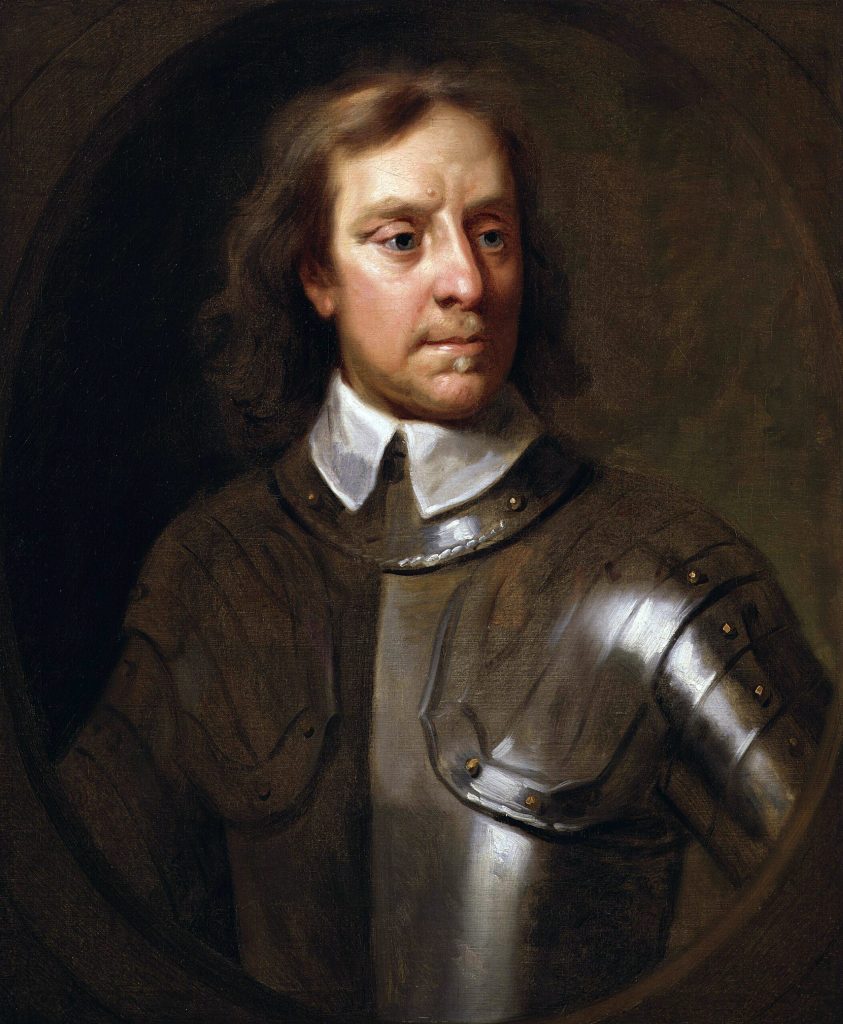
This was a fundamental misunderstanding of both Cromwell’s intentions and the army he commanded. No one in the Irish war had been able to keep a large force together for any significant amount of time. There was too much division between commanders, not enough supplies, and certainly not enough pay for anything other than brief campaigns which, more often than not, failed to achieve a great deal. No one, that is, until Cromwell arrived at the head of a unified and experienced army, with an undisputed chain of command, a warchest of 3 months pay, and the backing of the militarised English state. He had brought the latest in siege artillery with him, with experienced crews and a plentiful supply of ammunition; where the factions of the Irish war had been limited to lighter field pieces, he had monsters that could level city walls in hours, and he had lots of them. Cromwell was not content to sit outside city walls for months, and with his artillery train being ferried and dragged along with him, he would not have to.
He also had no intention of following the tradition of English generals sent to Ireland since days gone by; humiliating defeat, or political obscurity. He was determined to settle the Irish war quickly, and then return to England in triumph. If his opponents on the Council of State hoped that sending Cromwell to Ireland would sideline him, they would be very disappointed. He would also resist calls to return until he was ready; even as Scotland began looking more and more royalist, Cromwell dragged his feet in responding to parliament’s urgent summons home. Ireland could no longer be left smouldering to the side as it had been since the rebellion erupted 8 years earlier. Cromwell explained his priorities to the Council of State earlier in the year,
I had rather be over-run by a Cavalierish [Royalist] interest than a Scotch interest; I had rather be over-run with a Scotch interest than an Irish interest; and I think of all, this is the most dangerous, and if they shall be able to carry on with this work they will make this the most miserable people on earth.
Once in Dublin and after organising his men, Cromwell issued a proclamation to the people of Ireland. Titled ‘A Declaration of the Lord Lieutenant of Ireland: For the undeceiving of deluded and deceived people, which may be satisfactory to all that do not wilfully shut their eyes against the light.’ It’s fairly lengthy, and mostly acts as a reply to declarations from the Royalists and the Catholic clergy. Near the end, Cromwell offers ‘merciful consideration’ to any royalist who immediately lay down their arms or defected, except for the leaders who would be made examples of. He also promised that his soldiers would pay for their supplies, and that any of
‘the soldiery be insolent upon them [the Irish], upon complaint and proof, it shall be punished with utmost severity, and they [the Irish] protected equally with English men.’
But if this is the carrot, Cromwell was clear about the stick;
‘but as for those who notwithstanding all this persist and continue in arms, they must expect what the Providence of God will cast upon them,’ and his final line in the declaration warns that if anyone continued to fight, ‘I hope to be free from the misery and desolation, blood and ruin, that shall befall them, and shall rejoice to exercise utmost severity against them.’
With his army ready, and his declaration published, Cromwell chose his first major target; Drogheda, about 30 miles, or 50 kilometres, north of Dublin. His overall strategy aimed at Munster, the heartland of royalist opposition, but Drogheda was too close to Dublin to be left in hostile hands. Leading 12,000 men out of the capital, he began his march up the coast. With control of the seas, his artillery was ferried by ship. After two of his soldiers stole some chickens from an Irish farm along the road, the Lord Lieutenant put his promise into action; the soldiers were summarily hanged as thieves.
Meanwhile, Ormond was well aware of Cromwell’s target. In this first test of Cromwell’s resolve, he gave the defenders of Drogheda every advantage he could spare. Reinforcements, including his own regiment as well as several of Inchiquin’s, raced to Drogheda with a new governor at their head. Arthur Aston took over command from the previous governor, who Ormond suspected might surrender, and he shut the gates.
Aston was an experienced soldier who had fought in the armies of the first Romanov Tsar of Russia, Sigismund III of Poland, and Gustavus Adolphus of Sweden. He retired from his military career in 1639, bought a Cheshire estate, and settled down for a peaceful life. But of course, the Wars of the Three Kingdoms intervened, and Aston fought in the 2nd Bishops War, and then on the Royalist side of the First English Civil War, fighting at Edgehill and Newbury. Aston was a Catholic, though, and this kept leading to friction within the Royalist ranks, as did his severe demeanour. By all accounts, he was just a bit of asshole. While Govenor of Oxford, the Royalist Capital during the war, he annoyed almost everyone except the Queen, and in February 1644 he actually beat up the Mayor of Oxford and was put in time out, under house arrest for a month. Despite, you know, fighting the mayor, he remained Oxford’s military governor until September, when he broke his leg riding and had to have it amputated. His enemies in Oxford, which presumably included almost everyone, quickly took advantage of his injury and had him removed from office. After recovering from his surgery, Aston tried to get reappointed to various commands but he was too disliked in England, and so when Ormond returned to Ireland in 1648, Prince Rupert put in a good word for him, and Aston sailed over to join the resurgent royalist cause there. Aston’s reputation was that of a hardbitten siege defender, and so when Cromwell’s target became clear, and Drogheda’s incumbent governor looked a bit shaky, Aston was sent in to literally hold the fort.
Drogheda itself is split in half by the River Boyne, and in 1649 the smaller portion of the town was on the south bank. The fortifications were tall but relatively thin curtain walls. The garrison was about 3,000 strong, and of those at least four hundred were English.
Drogheda’s population was far from united. Its citizens and defenders were made up of every ethnic, religious, and political group in Ireland, and especially among the New English. There was a lot of pressure on Aston to surrender, and as Cromwell’s army approached he was forced to contend with several plots to hand the city over to the Lord Lieutenant. In one of these conspiracies, the plotters were some of the leading women of the city, including Aston’s own grandmother, Lady Wilmot. Aston was furious with her, and had her and her co-conspirators expelled from Drogheda.
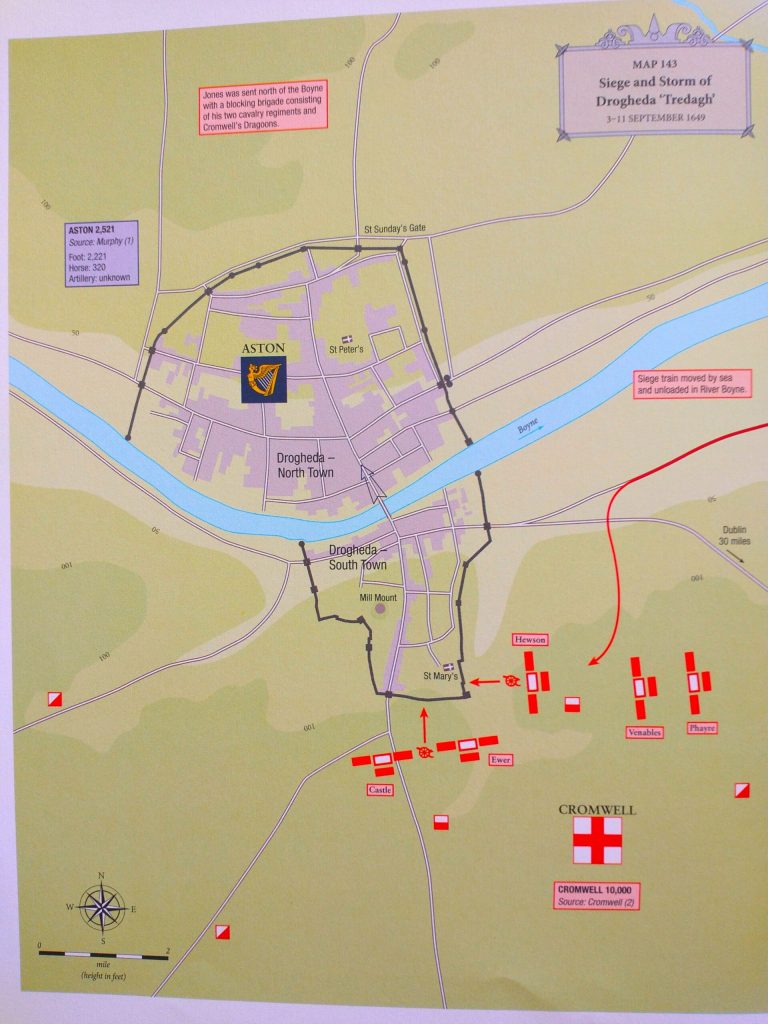
The Siege and Storm of Drogheda ‘Tredagh’, from Nick Lipscombe, The English Civil War: An Atlas and Concise History of the Wars of the Three Kingdoms, 1639-51., p. 302.
When Cromwell’s army reached the outskirts of Drogheda on the 3rd of September, someone suggested splitting the army in order to besiege the town from the north and the south, but Cromwell seems to have shot this idea down. Not only would it be difficult to coordinate and communicate across the river, but it would allow the defenders to focus on one half of the army first, before turning to the other. Besides, he had no intention of starving the defenders into submission. Lenihan describes Cromwell’s siege tactics as ‘crude’; If siege warfare was an art, Cromwell was doing fingerpainting. Lenihan notes three stages of siege warfare. The first was to surround the town or fortress, the second was to build siegeworks to encroach on the defenders and protect against outside interference, and allow the walls to be targeted by sappers or close range artillery. The third phase was an assault, either with ladders over the walls, or through a breach formed by the 2nd phase. Lenihan notes that Cromwell often rushed to the third phase as quickly as possible, sometimes skipping the first two entirely, and relying on long range artillery fire to force breaches in the walls.
Once at Drogheda, he sent Jones at the head of a force of cavalry and dragoons, to intercept any aid from the north. On the 9th of September, he ordered his artillery to take position, aimed at the south-east corner of the walls, and ordered them to open fire on the wall towers closest to them, and they were quickly destroyed. Then, under a white flag of truce, he summoned Aston, and demanded his surrender,
Sir, having brought the army of the Parliament of England before this place, to reduce it to obedience, to the end that the effusion of blood may be prevented, I thought fit to summon you to deliver the same into my hands to their use. If this be refused, you will have no cause to blame me.
Aston did not respond to Cromwell’s liking, and the flag of white was lowered and replaced with one of blood red, and the artillery opened up again. Indeed, Aston wrote to Ormond and swore that he and his garrison were, ‘unanimous in their resolution to perish rather than to deliver up the place.’
This sounds like bravado, but it was the likely outcome if the town fell after resisting. We’ll touch on this more later, but the expectations around sieges would be well known to an experienced soldier like Aston. By rejecting the summons to surrender Aston was well aware that he put his and his men’s lives at risk if Drogheda fell. But Lipscombe notes that Aston was expecting to delay Cromwell, not hold him off forever. He expected and hoped that Ormond would arrive with the full force of the Royalist coalition, and either bring Cromwell to battle outside the walls of Drogheda, or force him to call off the siege and withdraw.
But Ormond was not going to arrive. The instability and provincial priorities of his coalition were hampering his strategy. On the 12th of August, Owen Roe O’Neill’s truce with the parliamentarians had expired. Perhaps seeing that Ormond’s royalists were a lesser evil to Catholic Ireland than the English Parliament, on the 28th of August O’Neill sent word to Ormond that he was open to a deal. With Rinuccini long gone, it seems like O’Neill’s demands had mellowed. Once Ormond promised O’Neill that, after a Royalist victory, Ulster Gaelic landowners would be able to recover their land, a deal was on the cards. Now, how the redistribution of this land - some of it under new owners for years, if not decades - would take place was a problem for later. By mid-September, O’Neill had joined the royalists, but he was hesitant to leave Ulster, even to aid Drogheda. Likewise, Ormond urged the Marquess of Clanricarde, Ulick Burke, to send forces from his base in Connacht, while Inchiquin was reluctant to send anyone from Munster. Without these reinforcements, Ormond was left with a token force which was in no position to seriously counter Cromwell’s siege.
After Cromwell’s demand to surrender had not been followed, he’d ordered his guns to open fire. The artillery targeted the most southerly portion of the walls, hitting both sides of the south-east corner, in which the church of St Mary sat. Once the walls were breached, that church could be taken as a foothold, and the rest of the army could quickly follow. Once the artillery opened up, it took two days and more than 200 cannonballs, but Drogheda’s high walls quickly crumbled. The walls of Drogheda were key to Aston’s defence of the town, and Ormond’s strategy of delay, and they had fallen more quickly than either had expected or feared. At 5pm of the 10th of September, Cromwell ordered an assault.
Two columns advanced towards the breaches on either side of the corner. Aston had spent his time fortifying the other side of the walls, so when the attackers reached the breaches, they faced a dug-in and prepared enemy. The defenders successfully pushed both assaults back out of the walls and down the hill on the other side. But Cromwell had been prepared for this possibility, and two regiments were on hand to quickly reinforce the attack, and the situation reversed. The Royalists were forced back inside the walls, and then over their defences. The fighting was fierce inside the town, and when one of Cromwell’s colonels was shot in the head and killed, Cromwell himself charged into the fight to keep the men from breaking and maintain the momentum of the attack. Soon after, the attackers secured their positions and the rest of the army flooded in. The defenders fell back north and across the river, with parliamentary soldiers close behind them. Aston and around 250 officers were cut off on the south side, and holed up a fortified mill on the appropriately named Mill Mount. Aside from some remaining resistance, Drogheda had fallen.
Now came what even Cromwell’s sympathetic biographers call a ‘day and night of uncalculated butchery.’
It’s commonly said that it was seeing the fighting at close range and the bodies around that breach that sparked Cromwell’s famous rage. His men were wounded, dying, and dead, because Drogheda’s defenders had not surrendered. Enraged, Cromwell shouted “No quarter!” to his men, and let them loose. In his later report to parliament, he informed them that ‘being in the heat of action, I forbade them to spare any that were in Arms in the Town.’
Aston’s plan, in the event of a breach, had been to fall back across the River Boyne and pull up the drawbridge; but the pursuing parliamentarians were too close behind, and they spilled into the larger northern part of the town. With their commander trapped on the other side of the river, any focused resistance was destroyed. Many fled the town through the northern St Sunday’s Gate, while hundreds of others barricaded themselves at various points across Drogheda.
Aston’s holdouts at Mill Mount were convinced to surrender by Lieutenant Colonel Daniel Axtell, but Cromwell reports in his letter to parliament that he had already ordered them all put to the sword. So once they laid down their arms, they were taken prisoner, locked in the windmill, and then executed. Famously and possibly legendarily too, Aston was beaten to death with his own wooden leg, which was then smashed to pieces by soldiers seeking hidden treasure.
Royalist soldiers took refuge in St Peter’s Church and, after being driven back into the church tower, refused to surrender. Cromwell’s troops filled the foot of the staircase with the church pews and set it alight, turning the steeple into a funeral pyre. Those who fled the flames were killed by the waiting soldiers. Reportedly one man jumped from the burning tower and, somehow, survived with a broken leg. The soldiers who witnessed it might have killed him anyway, but instead he was spared because they were just so impressed.
As the false light of burning buildings and people gave way to sunrise, the killings continued. Royalists who had held out in the wall towers of St Sunday’s and West Gate were asked to surrender, and when they refused a small guard was placed on them to wait them out. Eventually they’d get hungry and give up, and this worked. About 120 men came down. But before they’d given up, the soldiers in St Sunday’s Tower had fired down on the guards, killing and wounding several, and so after that tower surrendered all of their officers were beaten to death or, in the words of one of the killers, knocked on the head, and the regular soldiers were decimated, with one in ten of them likewise executed. The survivors, as well as the soldiers from the other tower, were taken prisoner for transportation as indentured servants to Barbados.
When the chaos of the sack ended, the bloodletting did not. Fraser reports the fate of the royalist Colonel Richard Boyle. He survived the chaos and had been taken prisoner, and five days later he sat at dinner with Lord and Lady More when a soldier entered the room. The soldier bent to whisper in Boyle’s ear, and then the colonel stood from the table and excused himself. Lady More, surprised at his sudden departure, asked where he was going. Boyle turned at the door, and simply answered, ‘Madam, to die.’ Then he stepped outside, and was summarily shot. The English infantry commander, Edmund Verney, survived the initial sack and seemed to have been spared, but as he was walking through occupied Drogheda - alongside Cromwell - he was lured away from the Lord Lieutenant, into a side street, and stabbed to death. Verney had violated his parole, after surrendering in the English Civil War, and someone clearly held a grudge.
These are just some of the examples of royalist soldiers being summarily killed during and after the sack. Cromwell reported in a letter to parliament that 2,000 had been killed, then later revised it up closer to 3,000. But besides the sheer number of men under arms killed, which by itself placed the Sack of Drogheda far above any other Irish siege massacre, it is in the fate of Drogheda’s civilians as well as its Catholic clergy and monks that the sack of Drogheda really gains its infamy. The clergy were not spared. To quote from Cromwell’s letter again,
I believe all their Fryers were knockt on the head promiscuously, but two, the one of which was Father Peter Taaff (Brother to the Lord Taaff) whom the Soldiers took the next day, and made an end of; the other was taken in the Round Tower, under the repute of a Lieutenant,and when he understood that the Officers in that Tower had no quarter, he confessed he was a Fryer, but that did not save him.
But it’s the fate of civilians that really gets the historiographical ink flowing around Drogheda. Now, in any early modern sack of a town or city, civilians suffer robbery, violence, rape, and death. The laws of war, which we will talk about, were almost entirely focused on the behaviour and fate of soldiers, not civilians.
The historical debate seems to come down to three words. And Many Inhabitants. These three words appear at the end of Cromwell’s published list of those killed in the sack. After listing the leading officers by name, then the numbers of junior officers, and the estimated number of rank and file killed, appear the words ‘and many inhabitants.’ Because Cromwell’s original letters to parliament in this period have not survived, the question is, were these words written by Cromwell in his original letter to parliament, or were they added by someone else before it went to print.
Lipscombe, in his atlas, argues that ‘there is no evidence that the massacre included civilians’, although he does acknowledge that there must have been some civilian deaths but that these were untargeted. Fellow military historian James Scott Wheeler also finds the claims of mass civilian deaths at Drogheda to be overstated, and he lists a number of contemporaries who witnessed or reported on the sack who make no mention of civilian massacres despite having no love for Cromwell. Antonia Fraser stands by the claim that the words ‘And Many Inhabitants’ were added by the printer, and not included in Cromwell’s original letter. Perhaps the most high profile advocate for Cromwell’s cause is Tom O’Reilly, whose work is praised by both Lipscomb and Wheeler, but relentlessly criticised by specialists on early modern Ireland.
One of these critics, Michael O’Siochru, points to evidence of Cromwell’s soldiers attacking civilians in their homes, including Protestants, who only survived to make these accounts because the officers in charge recognised some of the civilians. He also rejects the claim that the words ‘and many inhabitants’ were added by the printers without Cromwell’s approval. Parliament’s official printers would risk their positions if they interfered with an official document without permission. He also questions why parliament would have given their approval, or ordered the changes themselves. He concludes that, ‘the most straightforward answer is the correct one. In his report, Cromwell, who had witnessed the assault on Drogheda at close quarters, simply acknowledged that the casualties included many civilians.’
Nick Poyntz has argued that there may have been up to five versions of the casualty list floating around London’s printers over September and October, and that they might have all been drawing on a common source that was itself under revision. He also notes that the first three published versions included ‘and many inhabitants’, which gives weight to it being an accurate phrase.
Lenihan takes the position that, ‘If not written by him, the words [Many Inhabitants] form part of a single officially sanctioned publication associated with him, so ‘there is no getting around’ the two words.’ He states that ‘In short, I believe that Oliver Cromwell’s soldiers shot, clubbed, hacked, stabbed or incinerated most of the garrison of Drogheda, ‘many in cold blood’, and slaughtered ‘a significant number of civilians’.’
For myself, I agree with Lenihan and O’Siochru. It’s hard to believe that between 2 and 3 thousand soldiers were killed and that, first, all those counted as ‘under arms’ actually were soldiers and not civilians trying to defend themselves, and secondly, that the soldiers conducting a mass killing of this size would be disciplined enough to only target the defeated soldiers. Sacks are messy, and with casualty figures that high, we have to imagine that hundreds of civilians, at a minimum, were killed alongside the soldiers. There is debate over the evidence of civilian killings, but there isn’t any evidence I’ve seen that Cromwell or his officers specifically exempted civilians from harm, and if they had, they’d surely have emphasised that.
We also have to look at why the sack happened, and how Cromwell justified it to parliament and, to be honest, to himself. He even acknowledges in the letter excerpt I read at the start of today’s episode that, in any other circumstances, his orders and the actions of his army at Drogheda would be cause for remorse and regret.
Firstly, it was retribution for the acts of the Irish rebels of 1641. As Derek Hirst puts it, when Cromwell ordered the summary execution of Drogheda’s garrison, he was ‘stretching blood-guilt for the massacres of 1641 over all of them as he did so.’ This was despite the fact that Drogheda had not fallen to the rebel siege in 1641, had in fact remained in Protestant hands until the Second Ormond Peace, and a sizable portion of its garrison in 1649 was in fact English and Protestant. Cromwell knew all of that, and indeed the case has been made that it was those English who faced the most immediate and bloody reprisals for defying God’s judgement and fighting for the monarchy. It was English heads taken from the mass graves of Drogheda to be put on spikes in Dublin, not Irish. But perhaps, as Lenihan and Hirst have suggested, Cromwell ‘subsumed all the defenders and townspeople of Drogheda within the generalised guilt by retrospective association for the massacres of Protestants eight years earlier.’ By joining a coalition with Confederate Irish, who were tarnished by the massacres of the rebellion, Drogheda was deserving of punishment for those crimes too. But we have to remember that Cromwell’s letter was intended to be read to parliament, and then published. It was written with a public audience in mind.
And that leads into our second reason; the coverage of the Irish Rebellion would have made the Daily Mail or the National Post blush in its tabloid sensationalism. English and Scottish public opinion was firmly, passionately, in favour of punishing the Irish for the 1641 rebellion, and this combined with general anti Irish, anti Catholic, and especially anti-Irish Catholic sentiment which was rife in early modern England and Scotland. News of the sack was celebrated in many parts of England, although there were some pamphlets - mostly Royalists, but not all - who condemned the massive death toll. But there was a reason parliament passed the ‘No Quarter to the Irish’ ordinance at the height of the civil war. There’s a reason Irish soldiers taken as prisoners of war in England and Scotland were routinely executed, often singled out from other captives and hanged. Welsh camp followers in royalist armies were massacred, because they were believed to be Irish. As Lenihan points out, the sack may have followed the rules of war - more in a moment - but the scale of the slaughter would simply not have happened if it had been an English Royalist town.
That’s a third factor; Drogheda was not, to quote Lenihan again, a uniquely horrific atrocity in the context of the moral no man’s land’ of the Irish wars. He notes several other siege massacres in Ireland, conducted by soldiers of all three kingdoms. However, he notes that the English carried out more, and with higher casualties, than either Scots or Irish, and Cromwell’s actions at Drogheda and, as we’ll see next week, at Wexford, firmly secured that position.
And that leads us into the fourth factor, and the one most commonly used to defend Cromwell’s actions at Drogheda and Wexford. The Laws of War, or alternatively the Laws of Nations. In a siege, if the defenders are called on to surrender and they refuse, if the attackers then force their way inside, the defender’s were not guaranteed mercy or quarter, and it was not dishonourable to kill the garrison, even if they then tried to surrender. Cromwell summoned Aston to surrender, and even explicitly warned him that if he refused there would be consequences. Aston informed Ormond that he and his men were prepared to die rather than give up the town. Reilly has argued that, whatever the morality of Cromwell’s orders at Drogheda, ‘he certainly had the law on his side.’
Fraser states that once the walls fell, ‘no quarter at this point could possibly have been expected by the rules of war’ and ‘no such offer was ever made officially.’ But Lenihan points out that it’s a mistake to call these concepts ‘laws’, when really they were social and moral guidelines. Nevertheless, the eventual fate of the garrison wasn’t a surprise in itself - the defenders resisted, the attackers therefore owed them no quarter, and massacring the garrison wasn’t dishonourable in the very specific definition of early modern warfare. What was a surprise was the extent of the violence - defeated officers in other sieges, before and after Drogheda, would be executed for refusing to surrender, but their soldiers were usually disarmed, imprisoned or released on parole - at least in England. Even in Ireland, the deadliest siege massacre before Drogheda was Cashel, under Lord Inchiquin, with around 800 killings including civilians, and that was itself a rare event. In the rest of the Cromwellian Conquest, the officers of castles and forts who resisted would often be summarily shot, but often their men were left alive. Drogheda was horrorific, unprecedented in its scale and severity… and that was perhaps the point.
Again, in Cromwell’s own words, he hoped that the massacre of Drogheda would ‘prevent the effusion of blood for the future.’ That was after all the logic behind the customs of siege warfare - besiegers wanted the besieged to surrender quickly, and used the threat of incredible violence to secure that. In theory, it would save lives overall, but it required besiegers to follow through on the threat if needed. Drogheda was a grand and terrible example of what resistance to the English Parliament meant. Cromwell’s proclamation upon arriving in Dublin had been the carrot; Drogheda was a burning, bloodsoaked example of the stick. Now I’m unconvinced that Cromwell was thinking strategically as he looked over his dead and wounded men in the rubble outside St Mary’s church. I think the strategic value of sacking Drogheda and putting thousands of soldiers, and who knows how many civilians, to the sword was, at best, at the back of his mind at that moment. But afterwards, Cromwell certainly used this logic as part of his justification for Drogheda; thousands died, yes, but if it saved thousands more by scaring his enemies into surrender, then it would be worth it in Cromwell’s eyes. And he seems to have hoped so, because otherwise in his own words the slaughter of Drogheda’s garrison and citizenry ‘cannot but work remorse and regret.’
In this framework, it was a deterrent for future sieges. And it worked. As we’ll cover next time, in the weeks following Drogheda, Cromwell’s army will take several castles and fortified towns without a fight. No one wanted to be the next Drogheda.
To end today, I’ll quote from Lenihan, who concludes his chapter in Cromwell and Ireland: New Perspectives by saying,
Oliver Cromwell behaved like earlier commanders in Ireland. He was about as brutal as Inchiquin or Monck, probably less so than Tichborne, and certainly less so than Coote. That is faint praise.
This is adapted from the script for Season 3, Episode 4 of Pax Britannica. To find out more, follow the links on this website or go to Pod.Link/Pax to subscribe on your app of choice.
Join the mailing list!
Select Bibliography:
- Antonia Fraser, Cromwell: Our Chief of Men
- David Edwards, ‘Political Change and Social Transformation, 1603-1641’, Cambridge History of Ireland
- Ian Gentles, The English Revolution and the Wars in the Three Kingdoms, 1638-1652
- John Jeremiah Cronin and Padraig Lenihan, ‘Wars of Religion, 1641-1691’, Cambridge History of Ireland
- Patrick Little, Lord Broghill and the Cromwellian Union with Ireland and Scotland, 2004
- Nick Lipscombe, The English Civil War: An Atlas and Concise History of the Wars of the Three Kingdoms, 1639-51
- Micheál Ó Siochrú, (ed.) Kingdoms in Crisis: Ireland in the 1640s, 2000
- Micheál Ó Siochrú, Confederate Ireland, 1642-1649, 1999
- Micheál Ó Siochrú, God’s Executioner: Oliver Cromwell and the Conquest of Ireland
- Pádraig Lenihan, Confederate Catholics at War, 1641-49, 2001
- Pádraig Lenihan, ‘Siege Massacres in Ireland: Drogheda in Context’, in Martyn Bennett, Raymond Gillespie, and Scott Spurlock (eds), Cromwell and Ireland: New Perspectives
- Wheeler, James Scott, ‘Ormond and Cromwell: The Struggle for Ireland’, in Martyn Bennett, Raymond Gillespie, and Scott Spurlock (eds), Cromwell and Ireland: New Perspectives
- Martyn Bennett, ‘God’s Wall of Brass: Cromwell’s Generals in Ireland, 1649-1650’ in Martyn Bennett, Raymond Gillespie, and Scott Spurlock (eds), Cromwell and Ireland: New Perspectives
- Derek Hirst, ‘Security and Reform in England’s Other Nations, 1649-1658’, in Michael J. Braddick. The Oxford Handbook of the English Revolution